Showing posts with label British Museum. Show all posts

Thursday, 23 December 2010

I'm all alone

Learn more here.
-

The Book of the Dead

-
"Truth is in my heart, and in my breast there is neither craft nor guile. -- The Egyptian Book of the Dead
-
Today we went to the British Museum to see the Journey through the afterlife: ancient Egyptian Book of the Dead exhibition. It was a truly worthwhile visit. 

According to John Taylor, the curator of the exhibition:
‘Book of the Dead’ is a modern term for a collection of magical spells that the Egyptians used to help them get into the afterlife. They imagined the afterlife as a kind of journey you had to make to get to paradise – but it was quite a hazardous journey so you’d need magical help along the way. [Read more here.] [Want to read all the spells? Try here.]
I was fascinated by many of the things we saw (and listened to - the audio guide is highly recommended). Below are some of the things I found interesting:
  • The ancient Egyptians strongly believed in the power of the word, both spoken and written. Carved or painted images also had power. Their faith in words and images led them to believe that magical power could be activated when certain words were uttered or images created.
  • There are altogether about 200 spells in The Book of the Dead but usually a manuscript would contain only a selection of these spells. 
  • There is at least one thing that the Egyptians and the Chinese have in common: simplified characters. In many papyri made between about 1550 and 1100 BC, a special simplified script was used, now known as Book of the Dead cursive hieroglyphs.
  • Sometimes, texts were written on the surface of the coffin, used by the living to resurrect the dead. And inside the coffin were the spells needed by the coffin lodger. This makes sense. But what if the two sets of texts were accidentally reversed, I wonder?
The exterior and interior texts of this coffin were catered for different readership
  • Not everyone could read the traditional hieroglyphic script. Sometimes the Book of the Dead was written in hieratic, the script for daily life. The Book of Dead of Padiamenet, chief baker of the temple of Amun, for example, has only six spells and they were written in hieratic, probably the script he was more familiar with.
  • There were also pictorial funerary papyrus rolls available. The illustrations delivered the full power of the spells. Below are two examples demonstrating the results of correctly-cast spells:
spell 59. The Goddess Nut in a tree feeding Tameni and her ba spirit
spell 81A. Spell to transform into a lotus flower.
spell 87. Spell to transform into a serpent.
  • Surprise! Surprise! Between about 1500 and 1100BC most funerary papyri were made for men. Sometimes, wives were portrayed alongside their husbands but only the men were named. From about 1100 BC women also began to have their own papyri.
  • I think the woman below is smoking. Her name is Anhai and she was a Chantress of Amun and the Chief of the Musicians of two cults. Her high social status is reflected in the large size of her papyrus and the use of gold leaf to embellish some of the vignettes. 
Click image to enlarge
  • I like the image below. These are women portrayed on one papyrus; they are mourning the death of a family member. Must they all show their nipples? Are those red things nipples or parts of the garment? I am no costume historian. 
Click image to enlarge
  • Have you seen a mummy? Did you know how a mummified body is reanimated? Answer: "The Opening of the Mouth ritual reanimated the mummifed body. Originally a ritual to enable a new born child to breathe and feed, it was performed on mummies to restore their bodily faculties. By touching part of the face with special implements a priest made it possible for the dead to see with their eyes, breathe through their nose and speak with their mouth." Interestingly, the tools used in the ritual were also those used by midwives. 
  • Do not judge a person by his/her mask. Often, the mask did not reflect the real face of the deceased but how he/she would like to appear in afterlife. That's why these masks all seem to depict young countenances with smooth skin. Also, because the gods had gold flesh and blue hair, the masks were often covered with gold leaf and blue paint was used for hair.
  • After all the ordeal that the deceased went through, he/she faced the final judgement, during which his or her heart was weighed against a feather of truth. The heart would be fed to the Devourer (a female monster with a body that was part lion, hippopotamus and crocodile) if it was heavier than the feather; and if the heart was light, the dead person would be granted permission to fly with the Sun god to the Field of Reeds, which was an idealised version of Egypt.

    The interesting thing about the weighing of the heart is that during the process, the heart could speak and reveal unflattering secrets about the owner's life, which could affect his/her chances to advance to paradise. For this reason, there were spells to mute your heart. For example: "May nought stand up to oppose me at [my] judgment, may there be no opposition to me in the presence of the Chiefs (Tchatchau); may there be no parting of thee from me in the presence of him that keepeth the Balance!"

    Since one of the sins the Egyptians were judged for was lying, this seems like cheating. Still, it's better than having your heart eaten. 
Weighing of the heart
The exhibition is on until 6 March 2011.
-
-

Wednesday, 17 November 2010

British Museum

This post was originally written on 6th March, 2010.

One good thing living in London is that you can just take fancy and go to any number of museums, galleries, theatres whenever you want. Last Sunday, we went to the British Museum with two friends visiting from Canada. There's so much to see in the museum (our last visit was for this exhibition) and we really needed to choose which sections to go to, especially since we had other things to do that day.

I’d like to share with you some of my favourite items from the visit:


This is the "Younger Memnon" statue of Ramesses II which is said to have inspired Percy Bysshe Shelley's famous sonnet "Ozymandias". I remember studying this powerful poem for an exam and was very moved by it.


Look at these beautiful Egyptian inscriptions. I took a high resolution picture and if we are short of a cover image for Cha in the future, I’m definitely using this.


Some of you may have learnt that we are following A History of the World in 100 Objects. We looked for some of them when we were in the museum. Pictured above is Object No. 16, Flood Tablet. It tells part of the story of the Mesopotamian Epic of Gilgamesh, which is supposed to be the world's oldest piece of literature.

We were also taken by the following tablet, which shows a list of synonyms:


The description says: "Scribes sometimes encountered rare or otherwise difficult words. This list explains such words using synonyms, with each set of words paired up in parallel columns. In many cases the numeral ‘two’ (written with two vertical strokes) is used to express 'ditto'."

While the list of synonyms is arguably my favourite, Jeff's choice is the following item and it gets an obligatory mention:


Description: "At least six graves in the Royal Cementery contained a wooden game board inlaid with shell, red limestone and lapis lazuli for the game now known as the Royal Game of Ur. This is an early example of a game that was played all over the ancient Near East for about 3000 years. Early Dynastic III, 2600-2300 BC From Grave PG 513, Ur."


The above is another favourite of mine. It depicts "A lioness devouring a man in a thicket of stylised lotus and papyrus plants." Why do I like it? It just looks so sexy, don't you think?


Now, do you know who this beauty is? She's Cleopatra! A Cleopatra, not the Cleopatra, though. Look at this larger picture, she has a mole on her lips, just like me! Although Reid suggested that this particular Cleopatra is a bit 'pudgy' and that the 'beauty spot' may have been the result of the painbrush dripping, I am having none of that and am still happy to see that spot there! (We even drafted a literary dialogue about this.)


This is an odd mummy. Look at that adorable mummy of a fish in a wooden coffin! It's from the Ptolemaic or the Egyptian Romantic period, after 305 BC. We also saw mummies of cats (of course), eels, falcons, seahorses and young bulls.


This Easter Island statue, Hoa Hakanania'a, is also an object from the A History of the World programme. I have seen these statues on TV before and it was quite an experience seeing it with my own eyes, even though it was not on Easter Island. How he pouts!

One controversial theory most famously postulated by Jared Diamond suggests that the competitive construction of these statues by local leaders resulted in the deforestation of the Island, which led to the society's eventual collapse. If this is true, it is a warning about modern consumption. (You can read Diamond's article "Easter Island's End" here.)

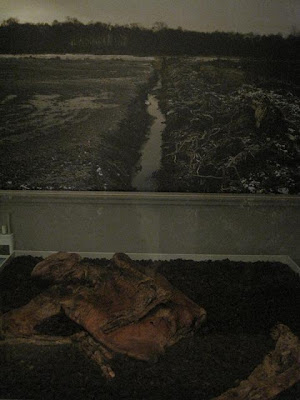
Our highlight of the visit, however, was Lindow Man. He is very low-key, being placed in a lowly-lit box away from the main attractions. Unless you are actively looking for him or happen to walk into his particular corner, you will likely miss the display. Lindow Man was found in a peat-bog at Lindow Moss. He was killed between 2 BC – 119 AD. The bog preserved his body so well that you can still see his features, including his beard and manicured fingernails. I found this naturally preserved Briton far more interesting than the Egyptian mummies.
Scientists discovered many facts about Lindow Man. Naked except for a fox-fur armband, he was 1.73m tall and weighed 64kg. He was around 25 years old when he died. He was well groomed, with trimmed beard and filed fingernails. Just before he died he ate a flat, unleavened griddle caked baked over an open fire. Several grains of mistletoe pollen were also found in his stomach. It is not certain whether he swallowed these deliberately or accidentally.

Lindow Man, you didn’t know you would be resting in the British Museum and visited by me, did you? [See a larger and clearer picture.]

One Response “British Museum” →

Irene
March 6, 2010
The Egyptian Hall is definitely my favourite! You’re so lucky to live in London!
-
-

Saturday, 6 November 2010

Moctezuma

This post was originally written on 8th November, 2009.

On Saturday, we went to the British Museum to see the special exhibition “Moctezuma: Aztec Ruler”. The display is about Moctezuma, the last real leader of the Mexica Empire. Despite the title, the curatorial notes made a big deal about calling their culture by their real name ‘Mexica’, not the more well-known name ‘Aztec’.

The exhibition was very clearly-presented. It started with some background about the Mexica and their creation myths, which have to do with an eagle and a human heart. I guess that’s why sacrifices involving human hearts were so central to their religious and cultural practices. We saw a number of vessels that were used for collecting hearts for rituals. The story then continued with Moctezuma’s immediate ancestors and then moved on to discuss his rule. Finally, it ended with the Spanish conquest. Not surprisingly, it focused a lot on the relationship between Hernan Cortés and Moctezuma. Their famous first meeting has been the focus of much research and debate. Although the exhibit doesn’t come down on one side or the other about what Moctezuma thought of Cortes, or weather Cortes had Moctezuma killed or not, their story was effectively described through a series of paintings which later Spanish residents of Mexico painted to educate settlers about the main historical events of the area. It certainly did seem, however, that Moctezuma, for all his great power, gave away his empire to the Spanish.

My only complaint about the exhibition was that there weren’t as many artifacts as I would have liked. Still, the pieces they did have were clearly presented and explained. I enjoyed the beautiful masks made out of turquoise mosaics, the various paintings, the stone remnants from the religious section of Tenochtitlan and from Moctezuma’s palace. I also enjoyed the descriptions of Mexica’s iconography and symbolism. For example, Moctezuma had a special insignia that was put on all the things he owned as well as many of the monuments built during his rule. The use of the traditional Mexica calendar was also fascinating. For example, many of the dates were also included on the statues and artifacts we saw, in a manner similar to the Western practice of putting the year a building was constructed on its wall.

Lastly, the most impressive piece of the exhibit is a huge stone monument to great warriors. To me, it looked like a throne designed to look like a miniature temple. The curator specifically located the piece directly under the oculus of the British Museum’s dome, signifying the central place the piece had in Mexica culture. There was perhaps some interesting comment about the nature of Empire in the curator’s decision to place such a symbolic piece at the heart of the British Museum.

One Response “Moctezuma” →

November 10, 2009
There’s quite an interesting book called “Sor Juana or the Breath of Heaven” “the Baroque-era Mexican nun, Sor Juana Inés de la Cruz. When she died in 1695, she was arguably the greatest writer working in any European tongue, though she never lived outside her native Mexico” from http://bit.ly/202joz Very well written, though very long and includes some of Sor Juana Inés de la Cruz’s poetry. There is a strong flavor of both the Spanish and the Aztecs. And the land itself plays a powerful role.
-
-
Related Posts Plugin for WordPress, Blogger...