Tuesday, 30 June 2009

Issue#8 Mud Luscious


The eighth issue (July 2009) of Mud Luscious (editor: J.A. Tyler) is now live. It includes work by Rauan Klassnik, Eirik Gumeny, Tomas Weber, Peycho Kanev, Joseph Goosey, Lisa Ciccarello, Chris Wilson, Hoa Ngo, Robert Scotellaro, Ethel Rohan, Heather Anastasiu, Brian Edward Bahr, Russell Thorburn, Mike Meginnis, Tia Prouhet, & Crispin Best as well as reviews of Damaged, Verb Sap, & Corn & Smoke.


J. A. Tyler's fiction was published in issue #1 of Cha.
-
-

J. A. Tyler in Breadcrumb Scabs


J. A. Tyler's new work "holy, holy" (p. 40) is now published in the July 2009 issue of Breadcrumb Scabs: a Poetry Magazine. You can download the issue here.

J. A. Tyler's fiction was published in issue #1 of Cha.

Monday, 29 June 2009

J. A. Tyler in Right Hand Pointing

J. A. Tyler's fiction "Inconceivable Wilson" is published in the 26th issue of Right Hand Pointing.
J. A. Tyler's fiction was published in issue #1 of Cha.

Xu Xi in Memorious

Xu Xi's prose "Servitude" is now published in the June 2009 issue (issue #12) of Memorious.


Xu Xi's creative non-fiction has been published in issue #6 of Cha.

Nirmala Pillai in Kritya

Nirmala Pillai's poem "Cock Crow at Mumbai" and two other poems, "Kerala, Bride of the Rain Gods" and "The New Script" are now published in the July 2009 issue of Kritya: A Journal of Poetry.

Nirmala Pillai's fiction has been published in issue #5 of Cha.

Wednesday, 24 June 2009

Ten Questions with Gillian Sze

"Ten Qustions with Gillian Sze" is up now on Open Book Toronto. Gillain talks about Fish Bones (her first full collection of poetry), her first publication (to our surprise it was a short story!), advice she has received as a writer, her next project, and more.


(Picture of Gillian by photographer John W. MacDonald. More of his works here.)

Gillian Sze's poetry has been published in issue #5 and issue #6 of Cha. She will be the guest editor of the February 2010 issue (issue#10) of the journal.

Ashok Niyogi in Word Catalyst Magazine

Ashok Niyogi's poems "We Talked About All This In The Car" and "Post Office On The Ridge" are published in the June 2009 issue of Word Catalyst Magazine. Read the poems here.

Ashok Niyogi's poetry has been published in issue #2 of Cha.

Gillian Sze in Black Heart Magazine

Gillian Sze's new poems "Wolf Call" and "Song of the Other" are now published in Black Heart Magazine, along with a review of Gillian's first poetry book, Fish Bones. Read the two poems and the review here.

Gillian Sze's poetry has been published in issue #5 and issue #6 of Cha. She will be the guest editor of the February 2010 issue (issue#10) of the journal.

Gillian Sze's Fish Bones reviewed

Gillian Sze's Fish Bones (published by Punchy Press) is reviewed in the latest issue of Black Heart Magazine.

Reviewer Laura Roberts says this about Gillian's poetry: "When done well, good poetry appears effortless. Sze’s poetry definitely seems as though she has strung words easily together[.]" Read the full review here.

You can also read a review of Gillian's chapbook, This is the Colour I Love You Best, here.


Gillian Sze's poetry has been published in issue #5 and issue #6 of Cha. She will be the guest editor of the February 2010 issue (issue#10) of the journal.

Poets in the Bookshop with Ivy Alvarez

Poets in the Bookshop with Ivy Alvarez


The Dylan Thomas CentreThursday, 25 June at 7.30pm


Ivy Alvarez is this month's guest poet at the Dylan Thomas Centre's Poets in the Bookshop on Thursday, 25 June at 7.30pm.


Ivy Alvarez was born in the Philippines, grew up in Tasmania and now lives in Cardiff. Her work has been widely published and performed, and she has held several residencies and won a variety of awards. Her latest full collection is Mortal (Red Morning Press).


"Sharpness of perception, whether of taste, eye or ear, is what defines this tightly written collection. The sharpness of the heart as mothers and daughters strain to find continuity, the sharpnesses of a sometimes painful, sometimes delightful present, and the deep poignancies of memory, are incised across these poems. Here's a striking new voice to accompany us from Hades to Tasmania, from myth to mother” - WN Herbert


The evening will also include an open mic session. For more information, please contact the Dylan Thomas Centre on 01792 463980 or see here. Tickets are £4-00 Full Price, £2-80 Concessions and £1-60 Swansea PTL.

Host: Dylan Thomas Centre
Date: 25 June 2009
Time: 19:30 - 21:30
Location: Dylan Thomas Centre
Street: Somerset Place
Town/City: Swansea, United Kingdom
Phone: 01792463980
Email: dylanthomas.lit@swansea.gov.uk


Ivy Alvarez's poetry has been published in issue #7 of Cha.

Tuesday, 23 June 2009

Kavita Jindal and the Poetry Society


Kavita Jindal will be organising the following events for the Poetry Society's Centenary in 2009 at Osterley Park & House, a National Trust property in London.

1. June 28 Poetry Tent and Poetry Competition
2. August 30 Poetry Workshop
3. September 27 Poetry Workshop

Please see here for more details

Kavita Jindal's poetry was published in issue #1 of Cha.

J. A. Tyler in Prick of the Spindle


J. A. Tyler's "& (thirty-three)" is now published in the latest issue (issue 3.2) of Prick of the Spindle. The new issue contains a fine selection of poetry, fiction, reviews, artwork and drama by Ken Narasaki.


J. A. Tyler's fiction was published in issue #1 of Cha.

Thursday, 18 June 2009

Anindita Sengupta in Origami Condom


Anindita Sengupta's four new poems "Desire. 15" (p. 24), "Totem" (p. 25), "Hide" (p. 26) and "Shoulders" (p. 27) are now published in the June 2009 issue (issue #13) of Origami Condom. Read the poems here (pdf).

Anindita Sengupta's poetry was published in issue #3 of Cha.

Wednesday, 17 June 2009

ASIAN CHA Issue#7 Editorial


-
UNDER THE MOON, UNDER THE RAIN-HAT
-
0
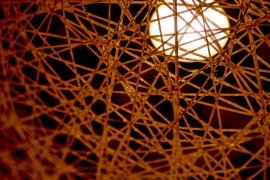
Normally, the process for choosing a cover image for an upcoming issue of Cha is quite straightforward, and my co-editor and I come to a consensus without much trouble. This time, however, the selection proved more challenging. Almost from the beginning of our discussions, two photographs stood out from the rest. Although we briefly considered others, in the end, we found ourselves scrolling between the original two images.

Perhaps surprisingly both pictures were not only taken by the same photographer, Enrica Ho (whose work you can see more of in this issue of Cha), but both were of the same subject. What made them so difficult to choose between was not, as you may expect, their similarities, but their differences. As you can see below, the images present two very different interpretations of the same frailly constructed sphere. In Picture 1, the viewer finds herself under a woven dome, gazing upward at an illuminated orb reminiscent of the moon. In Picture 2, the perspective has shifted to the outside; the viewer is now in orbit around a planet of intersecting flight plans. For us, both images were not only beautiful but presented compelling thematic possibilities. The dilemma was which one to choose.

Image
Picture 1
Image
Picture 2
In some ways, this was quite a high class problem to have—too much choice is undoubtedly better than not enough—but it was one that proved intractable. Eventually, we decided the only option was to ask you, our readers, to help us out by voting for the one you preferred. And you did not disappoint: your responses were both plentiful and perceptive. You also, as it turned out, ended up making our choice even harder. The votes were not as decisively one-sided as we had hoped, and your comments offered insights, which only gave us more to admire and think about. Proponents of Picture 2, for example, rightly praised its superior composition, especially its shallow depth of field and subtle investigation of shape. Others preferred the image for its evocation of freedom and otherworldliness—its feeling of celestial exploration. Finally, some of you seemed to settle on Picture 2 by default, choosing it because of qualities you disliked in Picture 1. For example, several readers said they found the moon in the first image slightly clichéd; others felt oppressed by the scene, trapped earthbound under a net. Interestingly, however, many among you who picked Picture 1, identified these exact same qualities as strengths. A number of people mentioned being enchanted by the poetic romance of the moon. Others admired the image for its reflection of our own position in the cosmos, pointed out that we too find ourselves earthbound looking up into an unattainable sky. A few of you even found comfort underneath the web; experienced not a sense of entrapment, but of being sheltered safely in a nest.

Despite your feedback, however, we were still left with a choice to make, and in the end, we went with Picture 1. This is to take nothing away from the second image, which in our opinion, is probably the technically stronger of the two. However it did not affect us in quite the same way; did not, as it were, hit us where we live. And where we live is earth. To us, the second picture’s suggestion of space, of other worlds, belonged more to the realm of science fiction than to the poetry of everyday existence. (Even writers capable of the greatest flights of fancy find their feet firmly planted on the ground.) In short, it was the point of view of Picture 1, that of a terrestrial observer gazing skyward, which eventually won us over. There is a powerful familiarity and equality in this perspective. We have all seen it, we all know it. Indeed, it would be hard to think of a reference point more universal than the moon or to imagine a subject of investigation which has left civilization with more cultural legacy assets. Think for example of the calendar or the countless myths and poems devoted to the moon. Does this make it then, as several readers suggested, a clichéd theme? Yes, undoubtedly. But then again, which of the eternal themes isn’t? When you have been watched as long as the moon, you are bound to evoke a feeling of déjà vu.

Much of the romance of the moon lies in exactly this sense that it has been seen before. Constancy and familiarity have been drawing gazes upward for thousands of years, and they drew ours to Enrica Ho's picture. And yet, we do not see the moon clearly in the photo; we are not offered the view of a stargazer in an untouched corner of the world. Instead we see it the way most of us do, filtered through a manmade filter. In Ho's photo, we could be looking at the moon through any number of screens: the frame of a thatched hut, the ceiling of a futuristic dome, the permanent partial eclipse of light and pollution provided by the modern city. Or perhaps we are seeing it though the metaphors of Han court astronomers who felt that "Heaven resembles a covering rain-hat, while earth is patterned on an inverted pan."

Today it may be tempting to look back at such ancient interpretations of the cosmos with a certain degree of amused condescension. Our understanding of space has certainly advanced since the inverted-panners advised the Emperor on celestial matters. We classify galaxies, calculate the gravity of collapsing stars, watch the expansion of an infinitive universe. A handful of us have even walked on the moon. But despite all these accomplishments, not much has changed in our basic relationship with the sky. We may find alien an ancient emperor's reliance on astronomers to maintain his heavenly mandate, but we would not be surprised to read about a politician who seeks prestige in a space program or rocket. A few of our astronauts can claim to have seen the view from the outside, experienced the otherworldliness of orbiting a frail sphere, but most of us still remain earthbound, trapped under the dome. And like our ancestors, we are still intrigued by celestial mysteries, susceptible to the wonders of an illuminated orb. The moon continues to exert its gravitational force upon us. And even if this force is not strong enough to pull us off the inverted pan, to yank us through the rain-hat, it is enough to lift our heads skyward and make us look.

Jeff Zroback / Co-editor
Cha
20 May, 2009
-

ASIAN CHA Issue#6 Editorial


THE YEAR OF THE SHOE

For a few days following the incident at Cambridge University in which a young German protestor threw a shoe at Chinese Premier Wen Jiaboa, the small thread of the web that originates from my house erupted in a stream of bilingual bursts. The incident proved to be of natural interest to my Chinese expatriate co-editor and her blogging friends, some of whom also live or have spent time in the United Kingdom. Their conversation mostly focused on whether Wen, speaking off-the-cuff after the shoe had been thrown, actually meant to describe the incident as "despicable" or whether it had been mistranslated and he had in fact intended something less forceful such as "mean" or "inappropriate". To me, their conversation was intriguing: partly because Chinese-Western relations is a topic ripe for speculation, and partly because I am fascinated by translation, an art for which I have the highest respect and absolutely no natural ability. (I remain in constant awe of my co-editor's ability to function in three languages more adeptly than I can function in one.)

I am not sure if they ever came to a decision. In some sense it did not matter. The audience at the event, much of it Chinese, seemed to consider Wen's reaction appropriate for such an obvious sign of disrespect. And as for everybody else, by the time my co-editor and her friends began translating the translation, "despicable" had already been set in the English record. For some who later saw the video, it seemed a strident response for what had actually occurred, the typical overstatement of a mainland leader unused to reacting to public criticism. (Wen's later call for leniency proved to be a much more adept piece of public relations.) In comparison to the Bush press conference, in which the assailant managed to get off two shoes in quick succession and right on target, the Cambridge protestor's efforts were decidedly lackluster, his missile falling harmlessly a few wide of the target. Likewise, if he had been hoping to have his gesture repeated endlessly as infectious viral video, the results were also less than stellar. With most of the action falling off screen, it certainly lacked the drama of a ducking Bush.

But even if anticlimactic and poorly executed, a shoe thrown at a world leader, especially one of Wen's stature, is an event that demands attention. In Britain, there were the predictable denunciations and apologies necessary to quell a diplomatic incident. In China, the story, after initially being held back by the censors, was released to predictable sentiment. It was not hard for Chinese nationalists (and they sort of had a point) to interpret the incident as another sign of Western disrespect for China. That the shoe was thrown at Wen certainly didn't help matters. In recent years, the premier has successfully nurtured an image of himself as the nation's benevolent grandfather. A few minutes spent looking through Chinese comments online, at least those I could read, revealed a common feeling: Who could throw a shoe at grandpa Wen? A German protester whose political aim was as bad as his arm, as it turns out. But never mind the political fallout — the shoe thrower's goal, whatever it may have been, was certainly not to win converts in the Middle Kingdom. And even if it were, extreme Chinese nationalists were not going to be convinced by his means of expression.

Sometimes there is a fine line between the personal and the political. This it turns out was one of those cases, as the incident found reflection in my own relationship with my co-editor. My reaction to the event, if not quite that of the shoe thrower, was at least to see Wen's retort as typically stiff and tone deaf. Then again, I am inclined to be weary of the Chinese leadership generally and I am completely deaf in all four Putonghua tones, so perhaps I am not the most impartial or accurate judge of these matters. The feelings of my co-editor on the other hand, while not jingoistic, certainly echoed the sentiment I had encountered online: that it was completely unacceptable, and vaguely mystifying, that someone had thrown a shoe at Grandpa Wen. Indeed, there is no topic of discussion, at least of a non-personal nature, more likely to cause tension between my co-editor and myself than Chinese politics. On more than one occasion, I have found myself reacting to a relatively innocuous comment about the country with an uncalled for, and only half-believed, tirade on human's rights, environmental degradation, Tibet, etc., etc. (Strangely, when speaking to my fellow Canadians, I often find myself defending the Middle Kingdom with lectures about the hypocritical West.) Conversely, my co-editor often personalises (sometimes surprisingly so for an Anglophile Hong Konger) even mild criticism of China, reacting with party one-liners and nationalists sentiments. No matter how such a conversation begins — I think once it was over whether we should have pasta or chow mien — the result is always the same. The overstated feelings of one will annoy the other, leading to a positive feedback loop of more strident views and less actual communication. Fortunately my co-editor normally has the common sense to say "Why are we fighting over noodles?" before these debates escalate to the point of actual shoe throwing.

Of course, the issues at stake in China's rise are infinitely more serious and complicated than what my co-editor and I should have for dinner, a fact which I find troubling. If two people who live together, aren't really that political and are comfortable with each other's cultures can get so worked up about Chinese-Western relations, what hope is there that the West and China will be able to work together. Now admittedly, you don't have to have read too deeply in psychology to know that many household fights about current affairs are as much about personal issues as they are about political ones. But I think there is more to our quarrels than displaced domestic tensions; there are also inherent cultural differences. And if we can't always manage these differences, how will political leaders, faced with protestors and cyber-nationalists, overcome them in a world of tightening resources and global warming. What if the shoe had been on target? What happens when the other one drops?

Then again, I saw another image during Wen's visit to England, one infinitely more striking than that of an off-target shoe. It showed a young Caucasian boy holding a sign written in Chinese that read "Happy Chinese New Year, Grandpa Wen." Maybe not all Westerners are tone deaf and find Chinese leaders stiff after all.

Jeff Zroback / Co-editor
Cha
18 February, 2009

Tuesday, 16 June 2009

CHA contributors and Sotto Voce Magazine


Cha contributors Bob Bradshaw and E.K. Entrada are in the editorial board of Sotto Voce Magazine. Bob is an assistant poetry editor and E.K. is an assistant fiction editor. Do check out the magazine for a well-selected range of poetry, fiction and art/photography. 

Bob Bradshaw in The Orange Room Review

Bob Bradshaw's new poem "The Deaf Boy in High School" is now published in the June 2009 issue of The Orange Room Review.
Read Bob Bradshaw's Cha profile.

In The Grove ISSUE 17 Summer 2009


The latest issue of In The Grove (founding editor and publisher: Lee Herrick) is now available online. It features the 2008 William Saroyan Centennial Prize winners; poetry from David Campos, Yu-Han Chao, Jennifer Kwon Dobbs, Charles Hood, Sam Pierstorff, Dixie Salazar, Soul Vang, C. Dale Young; nonfiction from Lucille Sutton & Jeff Tannen and fiction from Tim Z. Hernandez.

Lee Herrick's poetry was published in issue #4 of Cha.
-
-

Thursday, 11 June 2009

The Launch of Gilbert Koh's Two Baby Hands


Date: Friday, 19 June 2009
Venue: The POD, Level 16, National Library, Victoria Street
Time: 6.30 pm - 8.30 pm

Programme:
6:30 Guests sign in, tea reception begins
7:00 Publishers speak
7:15 Gilbert Koh speaks, reading
7:35 David Fedo speaks, reading
7:55 Book signing / book sales
8:30 Retire to a good read

Gilbert Koh's poetry has been published in issue #4 of Cha.

Gilbert Koh's Two Baby Hands


Gilbert Koh's poetry book Two Baby Hands (published by Ethos Books) will be officially launched on Friday 19 June 2009. The book can be purchased online from the Ethos Books website. Two Baby Hands will also be sold at Kinokuniya, Select Books and Books Actually, in Singapore.


Please see the above blog post for details of the launch of Gilbert's Two Baby Hands.

Gilbert Koh's poetry was published in issue #4 of Cha.

Monday, 8 June 2009

Arlene Ang and Jee Leong Koh in Holly Rose Review


-
-
Arlene Ang's poem "Things She Told the Rooster Before It Became Glass" and Jee Leong Koh's poem "Valentine to Volume" are now published in the second issue of Holly Rose Review.

-
 

  • Arlene Ang's poetry was published in issue #1 of Cha.
  • Jee Leong Koh's poetry was published in issue #6 of Cha.
0

Sunday, 7 June 2009

Mascara Literary Review 5

The fifth issue of Mascara Literary Review (editors: Boey Kim Cheng and Michelle Cahill) is now live. Read a fine selection of poetry here. Cha contributors Michelle Cahill and Cyril Wong (here and here) also have review articles published in the issue. One of the reviews by Cyril Wong is on Cha contributor Ouyang Yu's The Kingsbury Tale. There is also an interview with Cha contributor, Alvin Pang.

  • Michelle Cahill's poetry was published in issue #2 of Cha.
  • Alvin Pang's poetry was published in issue#2 of Cha.
  • Cyril Wong's poetry was published in issue#1 of Cha
  • Ouyang Yu's poetry was published in issue #4 of Cha.
-

Saturday, 6 June 2009

Arlene Ang in Boxcar Poetry Review


Arlene Ang's new poem "Living Without Water" is published in the May 2009 issue of Boxcar Poetry Review.

Arlene Ang's poetry has been published in issue #1 of Cha.

Friday, 5 June 2009

Anindita Sengupta in Nth Position


Anindita Sengupta's new poems "Separation" and "Speaking in Tongues" are now published in the June 2009 issue of Nth Position.


Anindita Sengupta's poetry was published in issue #3 of Cha.

Monday, 1 June 2009

Concelebratory Shoehorn Review 29


Issue#29 of Concelebratory Shoehorn Review (editor: Maurice Oliver) is now online. Read poetry by Frances Brent, James Brock, Cathy Smith Bowers, Jeff Colhoun, Lynne Hjelmagaard, Lori Kean, Beau Boudreaux, and Christine Garren. Also included in the new issue is photography of Mel Brackstone and art of Laura Wambsgans.

Maurice Oliver's poetry has been published in issue #3 of Cha.

Ceci Mourkogiannis in Literary Bohemian


Ceci Mourkogiannis's new poem "Chapatis for the Drive-By" appears in the most recent issue (June 2009, issue #5) of Literary Bohemian.


Ceci Mourkogiannis's poetry was published in issue #7 of Cha.

Ivy Alvarez in OCHO #24

Ivy Alvarez's new poem "What Vivien Leigh Dropped" is now published in the 24th issue of OCHO (Poets on Twitter Issue). Read Ivy's poem on p. 9 of the journal.

Ivy Alvarez's poetry has been published in issue #7 of Cha.
Related Posts Plugin for WordPress, Blogger...